Collagen supplements have become one of the most popular wellness products for women in midlife, often promoted as a solution for everything from wrinkles and joint pain to hair health and “anti-ageing”.
During perimenopause and menopause, natural collagen production declines as oestrogen levels fall, contributing to changes in skin, bones and connective tissue. But how much of the marketing is actually supported by science?
In this article, we’ll look at what collagen is, how the body uses it, and what the latest reliable research says about its benefits during perimenopause and menopause.
What is collagen
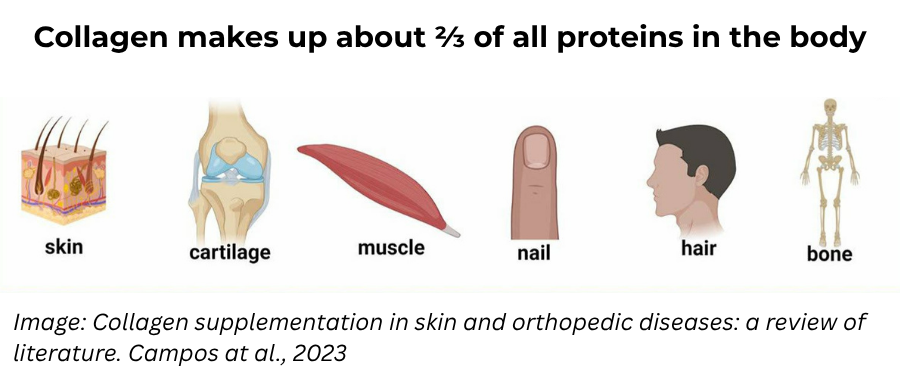
Collagen is the main structural protein in connective tissue. It makes up a large proportion of skin, tendons, ligaments, cartilage, bone and parts of blood vessels. Production naturally declines with age, and this decline accelerates during perimenopause and menopause because oestrogen helps regulate collagen synthesis and turnover.
In women, skin collagen content drops substantially during the first years after menopause, contributing to:
- reduced skin elasticity
- thinner skin
- increased wrinkling
- joint stiffness
- loss of bone strength
- slower tissue repair
Most collagen supplements contain hydrolysed collagen peptides (small protein fragments), gelatin (partially broken-down collagen, and less commonly, undenatured collagen.
Marine, bovine and porcine collagen are the most common sources , and most studies were done on these. Vegan collagen supplements are understudied.
The most important question:
Does dietary collagen become collagen in your skin, joints or bones?
The short answer is: not directly.
This is one of the biggest misconceptions in collagen marketing.
After ingestion, collagen is digested like other proteins:
- stomach acid and digestive enzymes break it down
- peptides and amino acids are absorbed in the small intestine
- these circulate in the bloodstream
- tissues may then use them as building blocks
The body does not automatically send collagen to the skin, hair or joints simply because a collagen supplement was consumed.
The amino acids can instead be used for:
- energy production
- synthesis of other proteins
- immune molecules
- enzymes
- muscle repair
- glucose production if energy intake is low
Some bioactive collagen peptides do appear to survive digestion and may act as signalling molecules that stimulate fibroblasts (cells involved in collagen production). That signalling effect is one of the main proposed mechanisms behind supplementation benefits.
However, this process is:
- variable between individuals
- dependent on total protein intake
- influenced by age, exercise, hormones and nutrient status
- not fully understood
Biochemical pathway: what happens after ingestion?
Digestion and absorption
Hydrolysed collagen is mostly made up of glycine, proline and hydroxyproline.
During digestion:
- collagen peptides are cleaved into smaller peptides and amino acids
- dipeptides and tripeptides may be absorbed intact
- hydroxyproline-containing peptides may enter circulation temporarily
Researchers believe these peptides may:
- stimulate fibroblast activity
- upregulate extracellular matrix production
- increase collagen synthesis signalling
But evidence in humans remains incomplete.
Importantly: Collagen is NOT A COMPLETE PROTEIN. It is lacking tryptophan, and essential amino acid, therefore should not replace a high-quality dietary protein.
What benefits have the strongest evidence in perimenopause and menopause?
1. Skin hydration and elasticity
Evidence strength: Moderate
This is the area with the strongest evidence overall.
Several recent systematic reviews and meta-analyses show modest improvements in:
- skin hydration
- elasticity
- wrinkle depth
especially in middle-aged and postmenopausal women.
A 2023 meta-analysis of 26 RCTs involving 1,721 participants found improvements in skin hydration and elasticity with hydrolysed collagen supplementation.
More recent 2024 trials also reported improvements in:
- skin elasticity
- skin imaging markers
- wrinkle appearance
But there are important limitations
A major concern is study quality and industry funding.
A recent 2025 meta-analysis highlighted that:
- positive findings were mainly seen in industry-funded or lower-quality studies
- higher-quality independent studies often showed little or no significant effect
So the evidence suggests:
- benefits are possible
- effects are usually modest
- collagen is not a “reverse ageing” treatment
- marketing claims are often exaggerated
2. Joint pain and connective tissue support
Evidence strength: Moderate
This is another area with fairly consistent evidence.
Collagen supplementation appears to modestly improve:
- joint discomfort
- exercise-related joint pain
- functional mobility
especially when combined with physical activity.
This is more relevant in menopause because declining oestrogen affects:
- cartilage integrity
- tendon stiffness
- inflammation
- musculoskeletal pain sensitivity
The strongest evidence is for:
- mild osteoarthritis symptoms
- exercise-related joint pain
- tendon/connective tissue support
The evidence is weaker for:
- severe arthritis
- structural cartilage regeneration
3. Bone health
Evidence strength: Limited to moderate
There is biological plausibility because collagen forms a major part of bone matrix.
Some studies suggest collagen peptides may:
- improve bone turnover markers
- support bone mineral density in postmenopausal women
However:
- evidence is still relatively small-scale
- trials are heterogeneous
- long-term fracture prevention data are lacking
At present, collagen is far less evidence-based for bone protection than:
- resistance training
- adequate protein intake
- calcium
- vitamin D
- menopausal hormone therapy when appropriate
4. Muscle mass and body composition
Evidence strength: Limited to moderate
Some evidence suggests collagen combined with resistance training may:
- modestly support lean mass
- improve strength
- assist connective tissue adaptation
But collagen is inferior to high-quality proteins such as whey for stimulating muscle protein synthesis because it lacks essential amino acids.
For menopausal women, preserving muscle mass is critical, but total protein intake and resistance exercise remain far more important than collagen specifically.
5. Genitourinary syndrome of menopause (vaginal dryness, pain, more frequent infections)
Evidence strength: Very weak / preliminary
A small 2025 pilot study investigated oral collagen peptides alongside radiofrequency therapy for GSM symptoms.
This is far too early to draw firm conclusions.
Currently there is insufficient evidence that collagen meaningfully improves:
- vaginal dryness
- urinary symptoms
- vulvovaginal atrophy
Compared with established treatments such as:
- vaginal oestrogen
- moisturisers
- pelvic floor therapy
What benefits are NOT supported by good evidence?
- Hair growth. Evidence is weak and inconsistent.
- Nail strength. Some small studies exist, but overall evidence quality is poor.
- Gut healing. Very popular online claim, but human evidence is minimal.
- Hormone balancing. No good evidence.
- Weight loss or metabolism boosting. No convincing evidence.
- Cellulite reduction. Insufficient evidence.
- Reversing menopause related aging. No evidence.
Why might some people notice benefits while others do not?
Response likely depends on:
- baseline protein intake
- exercise levels
- menopause stage
- smoking
- UV exposure
- genetics
- sleep
- total calorie intake
- vitamin C status
- overall dietary quality
Vitamin C is particularly important because it is required for endogenous collagen synthesis.
Without adequate protein, vitamin C, zinc, copper and energy intake, the body cannot efficiently synthesise collagen regardless of supplementation.
Important issue: industry funding
Collagen research has a substantial industry involvement problem.
Many trials:
- are manufacturer-funded
- use proprietary peptide blends
- are short duration
- use subjective outcome measures
This does not automatically invalidate results, but it lowers certainty.
The recent analysis separating independently funded versus industry-funded studies is especially important because effect sizes became much smaller when only higher-quality studies were analysed.
Safety
Collagen supplements appear generally safe for most healthy adults.
Potential issues may include:
- digestive discomfort
- bloating
- unpleasant taste
- allergy risk (marine collagen/fish allergy)
- contamination concerns with poor-quality products
Evidence for long-term high-dose safety remains limited.
Practical evidence-based conclusion for perimenopause and menopause
The current evidence suggests collagen supplementation may provide:
- modest improvements in skin hydration and elasticity
- small reductions in joint discomfort
- possible support for connective tissue and bone matrix health
However:
- effects are generally modest rather than dramatic
- evidence quality varies considerably
- many claims exceed what science currently supports
- collagen is not targeted directly to skin or joints after ingestion
- benefits depend heavily on the overall dietary and lifestyle context
For menopausal health overall, the strongest evidence supports:
- resistance training
- adequate total protein intake
- sufficient calcium and vitamin D
- sleep
- stress management
- smoking cessation
- balanced dietary patterns
- management of oestrogen deficiency where appropriate
Collagen may be an adjunct, not a cornerstone intervention.
Food first approach
A life-stage appropriate, balance diet will maximise the body’s collagen production. Before taking supplements, ensure that your diet has sufficient amounts of these:
- good quality, complete protein sources: a varied intake of meet, legumes and grains.
- fruit and vegetables rich in vitamin C: fresh berries, citruses, leafy greens, peppers, tomatoes.
- Zinc sources: meet, dairy, legumes, wholegrains, nuts and seeds.
- Calcium sources: small oily fish, oranges, dairy, leafy greens, legumes.
- Vitamin D sources: oily fish, mushrooms, eggs, liver, supplementation if required.
- Copper sources: organ meat, nuts and seeds, dark chocolate, wholegrains and legumes.
Key papers and reviews referenced
- Effects of Oral Collagen for Skin Anti-Aging: Systematic Review and Meta-analysis (2023)
- Impact of Collagen Peptide Supplementation with Physical Training: Systematic Review and Meta-analysis (2024)
- Impact of Specific Bioactive Collagen Peptides on Joint Discomforts: RCT (2024)
- Tuna Collagen Peptides and Skin Health Trial (2024)
- Hydrolysed Collagen Supplementation and Skin Health RCT (2024)
- Oral Collagen Peptides and GSM Pilot Study (2025)